Tactile paving is more than just a ridged surface on the ground. For a blind or visually impaired person, it is a complete navigation system that they "read" with a cane and through the soles of their shoes. But tactile paving comes in two fundamentally different types, and they must never be confused: directional paving shows where to go, while warning paving says "stop, there is danger ahead." Below we explain the difference between directional and warning tactile paving, the texture of each, and how they work together along a single route.
Directional tactile paving: guides you along the route
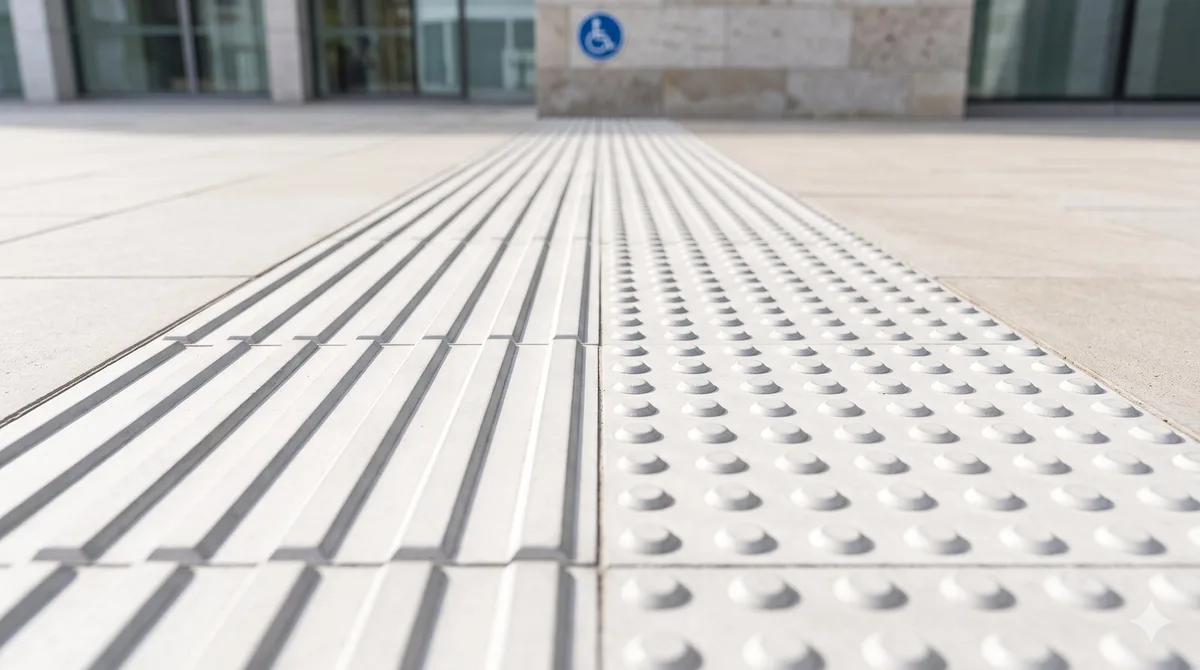
Directional paving has a texture of lengthwise bars — parallel raised "ribs" running in one direction. The cane slides along these bars, and the person understands: the path is clear, this is the way to go. The bars are always laid in the direction of travel, never across it.
- Texture: lengthwise bars (ribs) running along the route.
- Purpose: to set the line of travel and lead along a safe path.
- The message to the person: "keep going straight in this direction."
Warning tactile paving: a signal of danger
Warning paving has a texture of cones or squares (truncated domes) arranged in rows. Underfoot and under the cane, this texture feels completely different from lengthwise bars — it is a sharp, "dotted" signal. It means: a hazardous zone begins ahead, so stop and get your bearings.
- Texture: cones or squares (raised dots), not bars.
- Purpose: to warn of an obstacle or a change in level.
- The message to the person: "caution, danger ahead — stop."
How they work together along a route
On a real site, both types form a single chain. Directional paving leads the person along a sidewalk, lobby, or platform, and before each hazardous point it is interrupted by a strip of warning paving. The result is a clear "language": lengthwise ribs mean go, dotted texture means stop. If you use only one type, the system stops working: either the person doesn't know where to go, or they get no signal of danger.
Where to lay each type
The choice of paving depends on the task a particular stretch needs to solve.
- Directional — along sidewalks, in vestibules and lobbies, through long passageways, toward a building entrance, an information desk, or a checkout.
- Warning — before stairs (at the top and bottom), at the edge of a platform, before a pedestrian crossing, at the boundary of a hazardous zone, and in front of elevator doors.
Tactile paving for the visually impaired is only effective when its color contrasts with the main surface — the texture is read with a cane, while the contrast helps those who have some residual vision.
Common mistakes during installation
- The types are swapped: warning paving runs along the route, while directional paving sits before the stairs. The signal then means the opposite of what it should.
- Directional ribs are laid across the direction of travel — the person loses the line of the route.
- The strip of warning paving is too narrow, making it easy to "step over" with the cane without noticing it.
- There is no color contrast with the background — visually impaired people cannot distinguish the surface visually.
- Breaks and gaps in the directional line: the route "cuts off" and the person becomes disoriented.
All of these issues are resolved at the planning stage — designed with the requirements of applicable accessibility norms in mind.
Frequently asked questions
Can you get by with just one type of paving? No. Directional and warning paving solve different tasks, and only together do they create a clear and safe route.
How does a person tell them apart by touch? By the texture: lengthwise ribs feel like continuous bars under the cane, while cones or squares feel like separate raised dots. They are two distinct signals.
What color should tactile paving be? The color must contrast with the main surface. Yellow is most common, but what matters is noticeable contrast, not a specific shade.
Need help choosing?
We will help you determine where your site needs directional paving and where it needs warning paving, and lay out the correct route. View tactile paving in the catalog — and we'll advise on the right choice free of charge.