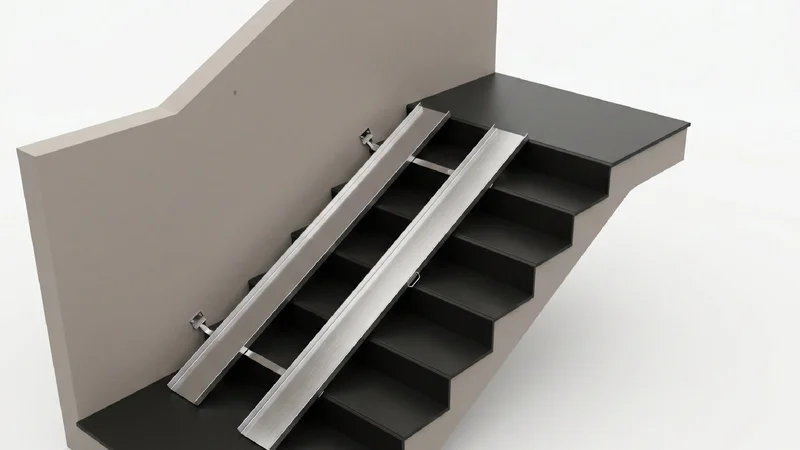

When you need to make an entrance accessible for a wheelchair user, a parent with a stroller or an older person, the choice comes down to one question: which wheelchair ramp to install. There are three main solutions on the market — the folding ramp, the fixed ramp and the portable ramp. They differ not in "quality" but in how they are used. Below we look at exactly how they differ and how to avoid a mistake when choosing.
Fixed ramp: a permanent entrance
A fixed ramp is installed once and stays in place. It is the go-to solution for a permanent entrance to a building — an apartment block entryway, a clinic, a shop, an office or a pharmacy. It is built for regular use and lets people get in and out comfortably on their own.
- Pros: reliable, gentle slope, can include handrails and a landing, convenient for daily use.
- Cons: takes up space, needs a prepared base and installation, cannot be moved.
This is the best option when the entrance is used every day by many people. During planning, the slope and width are set with the requirements of applicable accessibility norms in mind.
Folding ramp: when space is tight
A folding ramp attaches to a wall or a staircase and, when folded up, does not block the passage. It is lowered only when a wheelchair needs to pass and then raised again. This is the solution for narrow staircases, cramped entryways and shared stairwells, where a permanent structure would block the way for other residents.
- Pros: saves space, does not get in the way of pedestrians, locks in the raised position.
- Cons: usually designed for use with an assistant, since someone has to fold and unfold it; suited to short flights rather than large height differences.
A folding ramp is a compromise between permanent accessibility and a tight space where a fixed structure simply cannot be installed.
Portable ramp: mobility and one-off trips
A portable ramp (foldable, roll-up or telescopic) is not fixed in place and is carried with you. It is laid over thresholds, steps or at the entrance to a vehicle, and put away after use. This is the option for those who go to different places: visits to institutions, trips, temporary housing.
- Pros: lightweight, folds away, fits in a car boot, needs no installation.
- Cons: lighter models have a lower weight capacity, an assistant is needed, and it does not replace a permanent entrance for daily use.
If the main task is getting over thresholds and low steps in different places, a portable ramp handles it best.
How to choose: a quick guide
To make up your mind, answer a few questions about your situation:
- How often is the entrance used — every day or now and then? Every day means a fixed ramp.
- Is there room for a permanent structure? Little space or a shared staircase means a folding ramp.
- Do you need to carry the ramp with you? If yes, a portable ramp.
- What is the height difference and the weight of the user with the wheelchair? This determines the length and weight capacity.
- Will an assistant be nearby, or is independent access needed? For independent use, usually a fixed ramp with the right slope.
Common mistakes when choosing
- Too steep a slope: a short ramp looks compact, but getting up it on your own is hard and unsafe.
- Ignoring width: a ramp narrower than the wheelchair's track makes passage impossible.
- Choosing by price without considering the scenario: a portable ramp won't replace a daily entrance, and a fixed one is useless for trips.
- A smooth surface with no anti-slip coating — dangerous in rain and snow.
- No handrails where they are needed for safety.
Frequently asked questions
Can two types be combined? Yes. People often install a fixed ramp at the main entrance and keep a portable one for trips — this covers both everyday life and mobility.
Is a folding ramp suitable for independent access? It is usually designed for use with an assistant, because it has to be unfolded. For fully independent use, a fixed ramp with the right slope is generally better.
What determines the length of a ramp? The height difference: the higher the step or porch, the longer the ramp needs to be so the slope stays safe with the requirements of applicable accessibility norms in mind.
Not sure which type suits your entrance and user? Describe the situation — the height, the width of the opening and how often it will be used — and we will help you choose a solution. See the models in the ramps section and get a free consultation.