The phrase “barrier-free environment” is often reduced to a single ramp at the entrance. In reality it is a much broader concept — an entire system of solutions that lets a person with a disability enter a building on their own, reach the office they need, use the restroom, and receive a service on equal terms with everyone else. Let's look at what it really means and where to begin.
What a barrier-free (accessible) environment is
A barrier-free environment is the organization of space so that physical and informational obstacles do not stand in the way of a person with a disability. It is also called an accessible environment. The goal is simple: a visitor with reduced mobility should be able to use a building independently, without having to call for help at every turn.
Who it helps
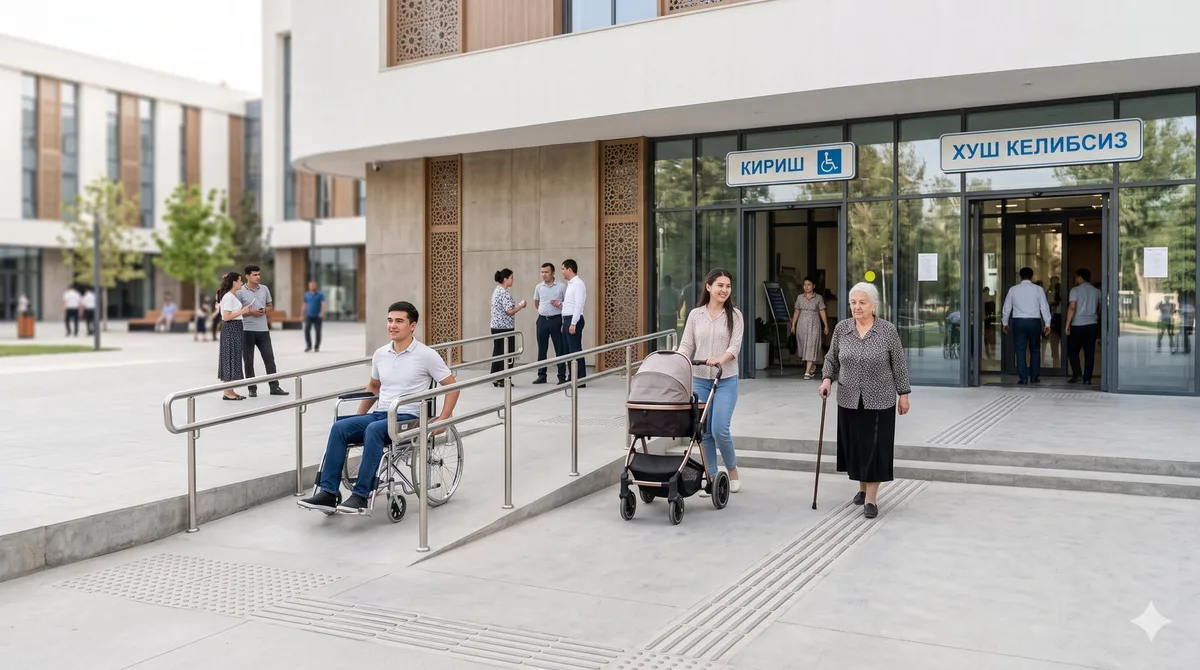
An accessible environment is not only for people who use wheelchairs. It is used every day by:
- people with visual and hearing impairments;
- older adults who find it hard to manage steps;
- parents with strollers;
- people with temporary injuries — for example, after surgery.
In other words, a convenient and clearly organized environment serves a wide range of visitors, not just one group.
What an accessible environment consists of
A complete barrier-free environment is made up of several groups of solutions:
- Movement: ramps, handrails, lifts, and doors and passageways that are wide enough.
- Wayfinding: tactile paving, tactile signs and tactile maps, high-contrast markings, and clear navigation.
- Sanitary areas: an accessible restroom with grab bars and enough room to turn a wheelchair.
- Communication and assistance: staff call buttons and call systems, and induction loops for people who are hard of hearing.
- Parking: dedicated accessible spaces near the entrance, marked with signs and road markings.
It is important that these elements work as a single chain — from the parking lot and entrance all the way to the final office. A lone ramp without navigation and an accessible restroom does not solve the problem.
Why it matters for organizations
Adapting a building is not only about meeting the requirements of applicable accessibility norms. It also broadens your customer base, builds a reputation as a socially responsible organization, and simply makes things easier for every visitor. A shop, clinic, or bank that is easy for anyone to enter earns more loyal customers.
How to start the adaptation
It is best to begin with an audit: walk the visitor's entire route from the parking lot to their destination and note where barriers appear — a high threshold, a narrow door, missing handrails, confusing navigation. Based on that list, you draw up a plan: what to do first and what can be done in stages. This approach helps you allocate the work sensibly and avoid overlooking important areas.
Common barriers and solutions
To grasp the idea of an accessible environment, it helps to look at specific obstacles and how they are addressed:
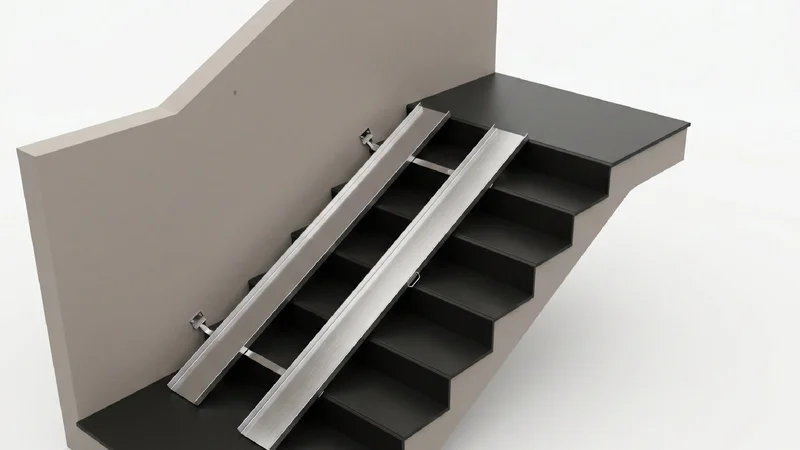
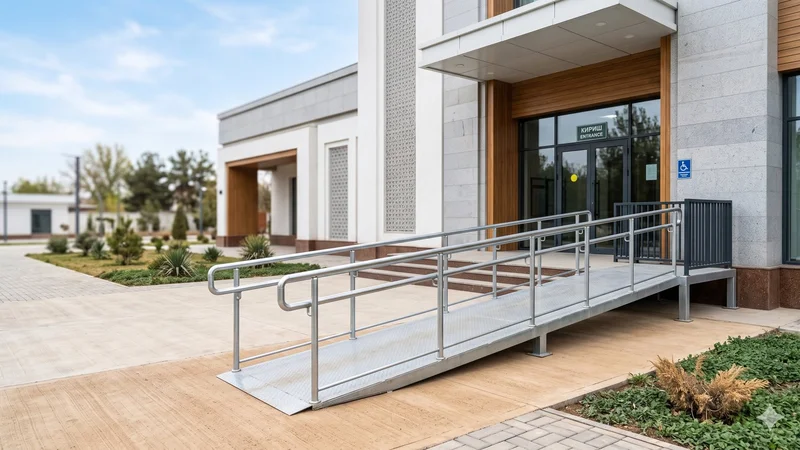
- A step or high threshold at the entrance — a ramp or a threshold ramp.
- A narrow door — widening the opening, easy-to-use handles, and a door closer with a delay.
- A slippery staircase — handrails on both sides and anti-slip strips.
- Not knowing where to go — a tactile map at the entrance, tactile paving, and navigation signs.
- An ordinary restroom — an accessible restroom with grab bars and room to turn a wheelchair.
- Nowhere to call for help — a staff call button at key points.
Each solution is simple on its own, but together they create a barrier-free environment.
Adaptation can be done in stages
There is no need to rebuild the entire building all at once. It makes more sense to move from the most important to the secondary: first secure the entrance and an accessible restroom, then navigation and call systems, and after that parking and additional conveniences. A phased plan lets you spread out the budget while making the building more accessible with every step. The key is for the solutions to combine into a single route rather than remaining isolated “islands.”
Frequently asked questions
Is a barrier-free environment necessarily expensive? Not always. Some solutions (high-contrast markings, tactile signs, a portable ramp, a call button) can be put in place quickly and noticeably improve accessibility.
Is installing a ramp enough? No. A ramp is important, but it is only one element. You need the whole chain: entrance, navigation, restroom, assistance.
Where should I start if the budget is limited? With an audit and the most critical barriers on the visitor's route — the entrance and the restroom. From there, the environment can be developed step by step.
We can help you carry out an audit, draw up an adaptation plan, and select equipment — from ramps to call systems. View the catalog or get a free consultation.