Tactile paving helps people with visual impairments find their way safely: the raised pattern felt underfoot or through a cane signals the direction of travel and warns of hazards. But not all paving is the same, and the right choice determines whether it will genuinely be useful. Below are five questions worth answering before you buy.
1. Directional or warning tiles?
These are the two main types, and they serve different purposes.
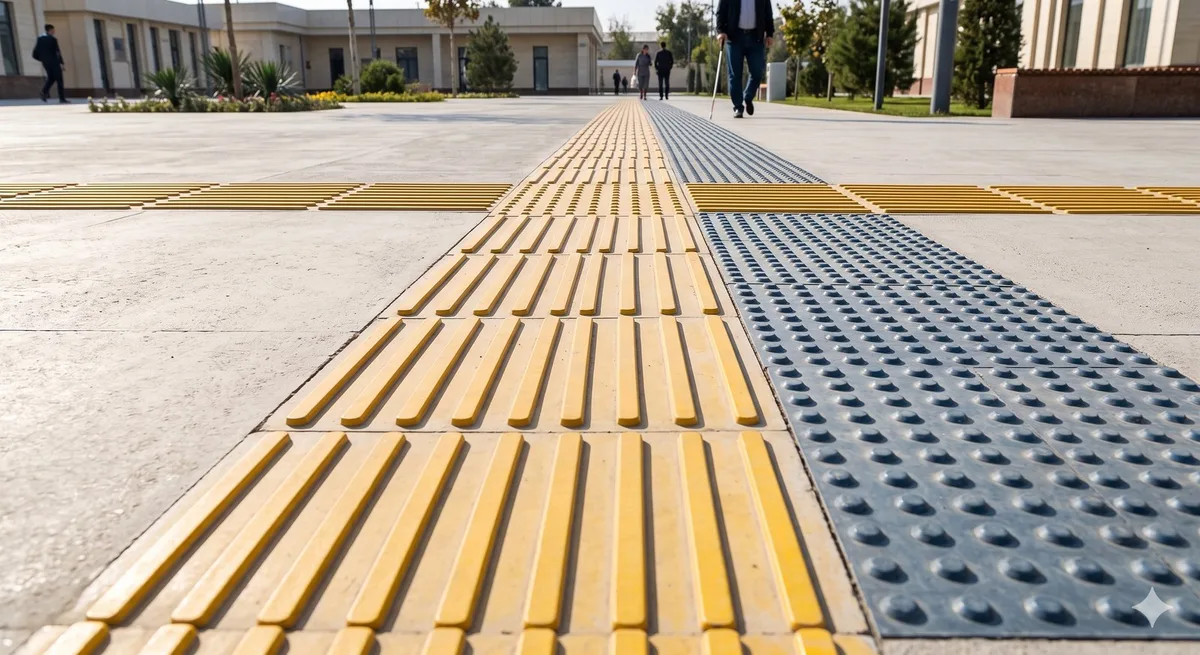
- Directional tiles have lengthwise ridges (bars). They show which way to go and guide a person along a safe route — for example, from the entrance to the lift or the checkout.
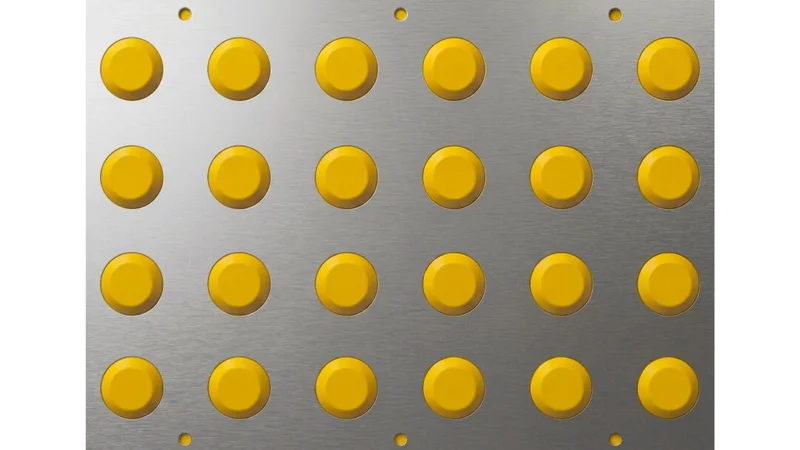
- Warning tiles have truncated cones or blister patterns. They signal a hazard: the top of a staircase, the edge of a platform, a pedestrian crossing, an obstacle.
Most sites need both types: directional tiles map out the path, while warning tiles mark the key points along it.
2. Which material?
The material is chosen to suit the conditions of use:
- Polyurethane and PVC — lightweight and easy to lay indoors over an existing floor.
- Rubber — flexible, slip-resistant and well suited to entrance areas.
- Concrete and paving slabs — for outdoor use and high foot traffic.
- Stainless steel and brass — individual tactile indicators (studs, bars) that are durable and look smart at entrances.
3. Which colour?
Tactile paving is needed not only by blind people but also by those with low vision who navigate by contrast. That is why the surface colour is usually made to contrast with the main floor — most often a bright yellow. Good contrast makes the markings easy to spot from a distance and reduces the risk of falls.
4. Where exactly should it go?
Paving is placed where a person needs to make a decision or where a hazard exists: at entrances, on stairs and ramps, at stops, near pedestrian crossings, and in the lobbies of hospitals, schools and shopping centres. It is important that the tactile elements form one continuous route — fragmented markings throw people off track.
5. How much paving do you need?
The quantity depends on the length of the route and the number of hazard points. It is best to draw up a plan: mark the entrance, the path to the destination and every spot where a warning is needed. From that plan it is easy to calculate the running length of directional tiles and the number of warning sections. Our specialists can help with these calculations.
Common mistakes during installation
For paving to be truly helpful, it is important to avoid the typical mistakes:
- Gaps in the route. If directional paving is laid with breaks, the person loses the line of travel. The route must be continuous from start to destination.
- No contrast. Paving that matches the floor colour is almost useless for people with low vision — the visual cue is lost.
- Warning in the wrong place. Warning tiles are laid precisely in front of the staircase or edge, not “roughly nearby”.
- The wrong material. Lightweight indoor paving wears out quickly outdoors, while heavy outdoor elements are awkward to lay over an existing indoor floor.
Who benefits from tactile paving
Although paving is designed first and foremost for blind and low-vision people, other visitors also benefit from clear navigation: older people, children, and anyone in an unfamiliar building. A clearly marked route makes a space more comfortable for everyone and reduces the number of requests for help from staff.
How to care for tactile paving
Tactile paving works only when its raised pattern is easy to read. Over time, dirt, ice or wear can “smooth out” the pattern, so the surface needs to be cleaned and inspected periodically. Quality materials — polyurethane, rubber, stainless steel — keep their crisp relief and contrasting colour longer, even under heavy traffic. When choosing paving, it is worth considering from the outset how easy it will be to maintain in your space.
Frequently asked questions
Can I use only warning tiles? Yes, if the goal is simply to mark individual hazard zones. But full navigation also requires directional tiles.
Is outdoor paving suitable for indoors? Yes, though indoors it is usually more convenient to use lightweight polyurethane or rubber elements — they are easier to lay over an existing floor.
Does it have to be yellow? Yellow is the most common and high-contrast option, but the main thing is that the paving stands out clearly against the main surface.
We will help you choose the type and material and calculate the quantity for your site. View tactile paving in the catalogue or get a free consultation on design, delivery and installation.