
For a person with a visual impairment, a building without guidance turns into a maze. Ordinary signage is out of reach, and they have to navigate by touch and from memory. To make a space clear and safe, designers use tactile signs, tactile maps and tactile paving. In this article we explain what these are, what kinds of signs exist and how to build logical wayfinding for blind visitors from the entrance all the way to the right room.
What a tactile sign is
A tactile sign is an information sign you can "read" with your hands. The text and pictograms are raised, meaning they stand out from the surface, and right beside them the message is repeated in Braille — a system of raised dots read with the fingertips. Thanks to this, the very same sign can be understood by sighted, low-vision and fully blind visitors alike.
A good tactile sign combines large high-contrast type, a clear pictogram, raised characters and a line of Braille. Contrast matters for low-vision readers, while the raised lettering and Braille serve those who rely on touch.
Types of signs
- Room signs. The number and purpose of a space: "Room 204", "Reception", "Accounting".
- Floor signs. Placed near stairs and elevators, they indicate the floor number and what is located on it.
- Directional signs. Arrows and pointers such as "to the exit", "to the elevator" and "to the restroom" that lead along a route.
- Safety signs. Emergency exits and escape routes, repeated in raised form.
- Restroom markings. Restroom pictograms, including those accessible to wheelchair users.
How to build wayfinding for blind visitors
Tactile navigation only works as a single, connected system rather than a set of isolated signs. The route must be continuous: the person receives information at every key point along the way.
- A tactile map at the entrance. This is a raised floor plan with Braille. At the entrance, a blind visitor "surveys" the building with their hands and builds the route in their mind.
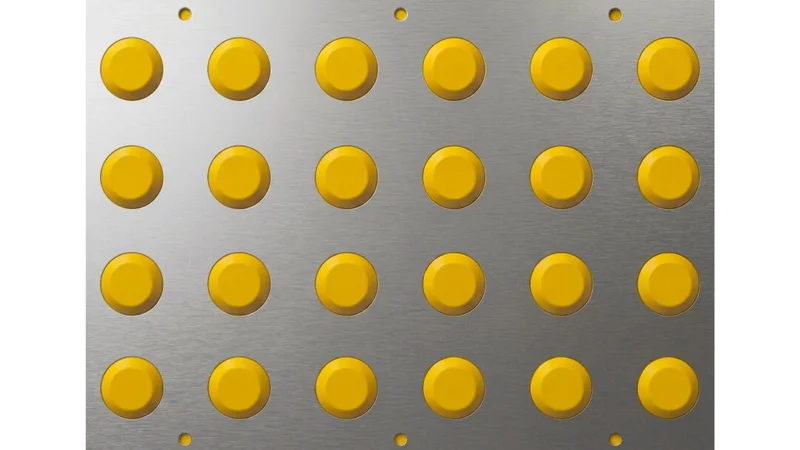
- Tactile paving. Guiding strips underfoot lead from the entrance to the stairs, the elevator and the desk, while warning studs signal an obstacle or the start of a staircase.
- Signs at decision points. At every junction, by each elevator and at each room door, a tactile sign confirms that the person is heading the right way.
The key principle is logic and consistency: identical signs in identical places, with no surprises and no breaks in the route.
Where and at what height to mount them
So that a sign is easy to find by hand, it is important to follow consistent placement rules, designed with the requirements of applicable accessibility norms in mind:
- Room signs are mounted on the handle side, on the wall next to the door rather than on the door panel itself — that way an opening door does not "sweep" them out of reach.
- The ideal height for the bottom edge of a sign is roughly 1.2–1.6 m from the floor, within a comfortable reach for the hand.
- The tactile map is placed right at the entrance, at an accessible height, so it can be examined while standing.
- The surface around a sign should be clear, with no protruding objects in the path of the hand.
Common mistakes
- The sign is hung on the door panel — when the door opens it becomes impossible to read.
- There is Braille but no raised lettering or contrast — low-vision visitors are left out.
- The signs are in place, but the route to them is not laid out with tactile paving — there is simply no way to reach them.
- The height and style of the signs differ on every floor — the system stops being predictable.
- The tactile map is out of date after a refurbishment and ends up being misleading.
Frequently asked questions
Is it mandatory to repeat a sign in Braille? Yes — without a line of Braille a fully blind person gets no information. Raised lettering and Braille complement each other and should always appear together.
Can you rely on signs alone, without tactile paving? Signs tell a person where they are, but they still have to reach them. Paving leads along the route, so the two work as a pair.
At what height should a room sign be mounted? With its bottom edge roughly 1.2–1.6 m from the floor, on the handle side, on the wall beside the doorway.
Let's make your wayfinding clear together
We will select tactile signs, tactile maps and tactile paving to suit your building's layout and help you build a logical route. Get a free consultation and explore the options in the catalog: signs and navigation.