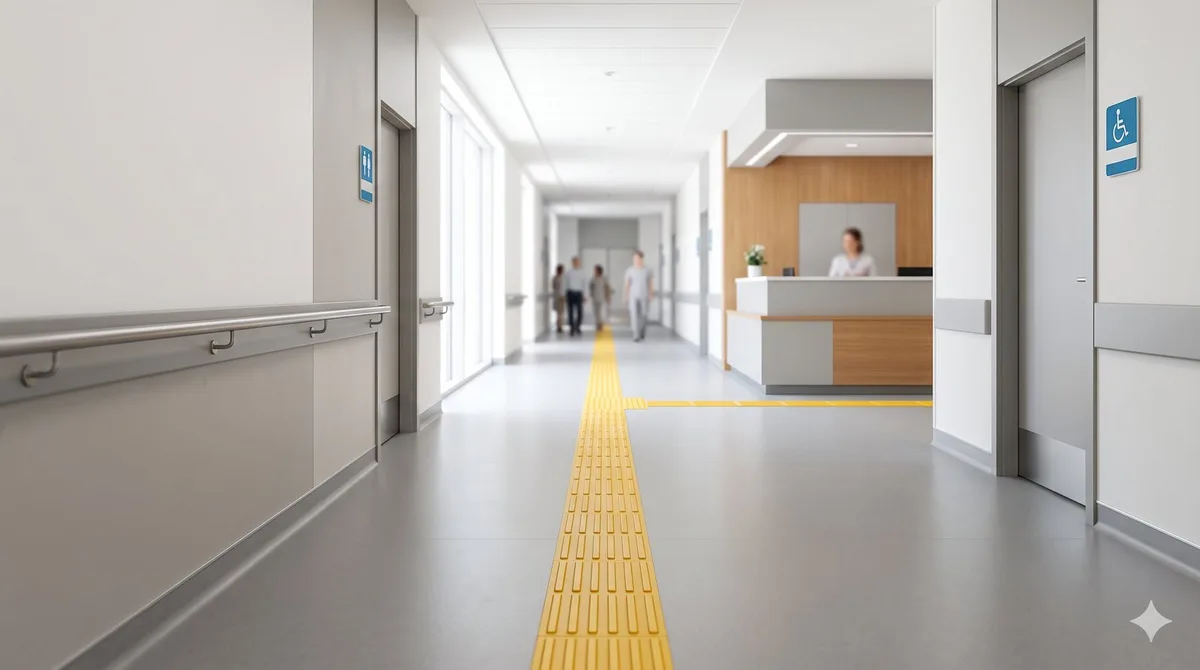
For a person with impaired vision, a hospital is a maze of unfamiliar corridors, staircases and identical doors. So that patients can reach the reception desk and the right consulting room on their own, without depending on chance assistance, a hospital needs a well-thought-out accessible environment. Below are 10 practical ideas you can realistically implement in a clinic or inpatient department, along with tips on where to start.
10 solutions for visually impaired patients in hospitals
These solutions complement one another: each works on its own, but together they deliver the greatest effect, forming a continuous route from the entrance to the consulting room.
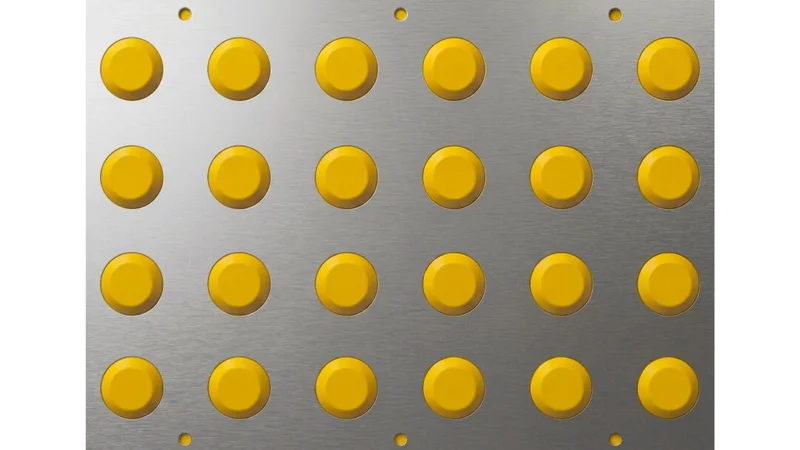
- Tactile paving to the reception desk. A guiding strip leads a person using a cane straight from the entrance door to the reception counter, while warning paving with raised cones marks turns and hazardous areas.
- A tactile map at the entrance. A raised tactile map showing the floor plan with Braille gives an overall sense of where the rooms are located right as you walk in.
- Tactile room signs. Each door carries a sign with raised numerals, high-contrast lettering and Braille, mounted at a convenient height.
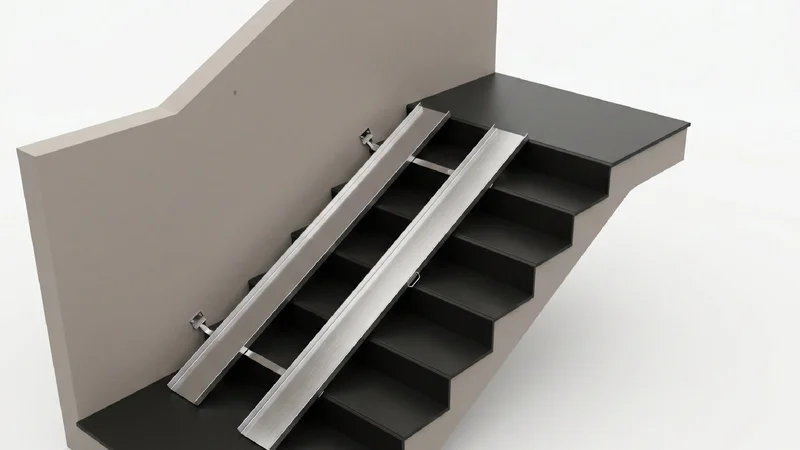
- High-contrast stair marking. Yellow anti-slip strips on the edge of the first and last step warn of the beginning and end of each flight.
- High-contrast doorways. Highlighting doors and frames in a colour that contrasts with the wall helps people avoid missing an entrance or walking into it.
- Audio guidance. Voice announcements and audio beacons at key points (entrance, reception, lift) indicate direction by sound.
- Tactile pictograms and signs. Raised-dot directional signs pointing the way to reception, the laboratory and the restroom.
- An accessible lift. Buttons with raised markings and Braille, spoken floor announcements and a high-contrast control panel.
- Anti-glare, even lighting. For visually impaired people, what matters is not brightness but the absence of harsh shadows and glare on floors and signs.
- Clear colour-coded navigation. A consistent colour logic for departments and large, high-contrast type on every sign.
Where to start
There is no need to do everything at once. Begin with the route that patients use most often:
- Walk the path "entrance → reception → lift/stairs → typical consulting room" and note where a person gets lost.
- First cover this main route with tactile paving and a tactile map at the entrance.
- Add tactile signs to the doors and high-contrast marking to the stairs.
- Choose every element with the requirements of applicable accessibility norms in mind.
How to tie the solutions into one system
A single strip of paving or one sign on its own changes little. The system works when the elements form a continuous chain: tactile paving leads to the tactile map, the map gives an overall plan, tactile signs confirm that a person is at the right room, and audio guidance reinforces the key points. It is important to keep a consistent style: the same colours, sign heights and navigation logic on every floor, so that patients can learn the principle once.
Frequently asked questions
What is the cheapest and fastest place to start? Tactile paving along the main route and a tactile map at the entrance — they deliver the greatest effect with the fewest alterations.
Is Braille necessary if few visitors are fully blind? Yes. Braille on signs and the tactile map is a basic element of an accessible environment, and its presence is taken into account by applicable accessibility norms.
Are these solutions suitable for an older building? Yes. Tactile paving, signs and high-contrast marking are installed without major renovation and adapt to the existing layout.
Want to equip your hospital so it is clear and safe? Take a look at tactile paving and accessible-environment elements and get a free consultation — we will help you map out the route and choose solutions for your building.