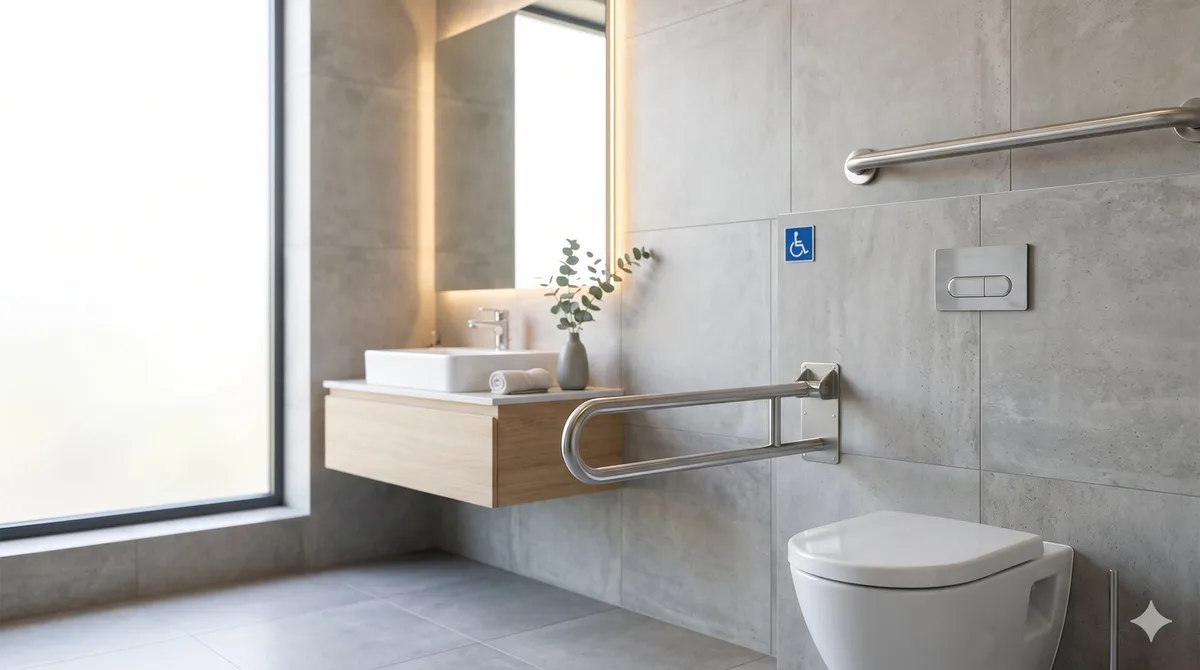
The bathroom is one of the most accident-prone spaces in any building: wet floors, smooth tiles, and the constant need to sit down and stand up all add up to a high risk of falls. Properly installed grab rails take a significant share of that strain off the user and make the space genuinely accessible. In this article we look at the types of grab rails available for people with disabilities and limited mobility, the height at which to mount them, and how to put together a set that actually works.
Types of bathroom grab rails
Choosing the right rails starts with understanding the task: where the person leans, sits, and turns. The main types are:
- Straight rails — a versatile horizontal or vertical support for a wall, the shower, or along a passage.
- Angled (L-shaped) rails — combine a horizontal and a vertical section, ideal in the shower and beside the bath.
- Folding rail — lifts up against the wall when not needed; essential next to the toilet, where keeping the approach clear matters.
- Toilet rail — a pair of supports on either side (folding or fixed) for safely sitting down and standing up.
- Bath and shower rails — help the user step in, step out, and keep steady on a slippery surface.
Height and positioning
Installation height is the key to comfort. Here are the reference points proven in accessible-environment practice:
- Horizontal rails by the toilet and in the shower — at a height of roughly 70–75 cm from the floor.
- A folding rail beside the toilet goes at the same height, projecting about 70 cm from the wall, with a gap of 55–70 cm between the pair of supports.
- The vertical section at the entrance to a shower or bath — with its lower end at around 80–85 cm for a grip on entry.
- Tube diameter for a secure grip — 30–40 mm, with a clearance to the wall of at least 40 mm so the hand does not slip off.
Material and load capacity
Stainless steel is well suited to a wet room — it does not rust, cleans easily, and keeps its appearance for years. The surface can be polished or matte (non-slip); a matte finish is safer for wet hands. The tube is not the only thing that matters, the fixing does too: the flanges should be substantial, and installation must be into a load-bearing wall with reliable fasteners. Good-quality rails are rated for loads of 120–135 kg and up; use that strength margin as your guide and choose models with the requirements of applicable accessibility norms in mind.
How to build a set for an accessible bathroom
A minimum safe set for a typical bathroom:
- By the toilet — a folding rail on the approach side and a straight rail (or a second folding one) on the opposite side.
- In the shower — an angled rail plus a vertical support at the entrance.
- By the basin — a horizontal support if the person leans while standing.
- By the bath — a horizontal and a vertical section for getting in and out.
Start with the toilet and shower areas — that is where most falls happen.
Common mistakes
- Mounting into plasterboard or a hollow wall without backing — the fixing pulls out under load.
- Installing too high or too low — the support stops working when sitting down.
- A polished tube without a non-slip texture in a constant-grip area.
- A single rail where a pair is needed — the person cannot distribute their weight symmetrically.
Frequently asked questions
What rail diameter is the most comfortable? The optimum is 30–40 mm: a tube this size is fully wrapped by the palm and does not slip even with a wet hand.
Can grab rails be fitted to any wall? No. You need a load-bearing wall or backing for the fasteners; you cannot mount into plasterboard without reinforcement — the support will not hold the weight.
Why is a folding rail better than a fixed one? It lifts up against the wall and clears the approach to the toilet, which makes it convenient in tight bathrooms and when a wheelchair is used.
Need help choosing grab rails for your bathroom? Get a free consultation and pick out a set in our catalogue: bathroom and toilet accessories.