A ramp is needed wherever a person's path is blocked by stairs, a curb, or a change in level. But simply laying down an inclined surface is not enough: if the slope is too steep and there are no handrails, the ramp is unsafe to use — especially for a wheelchair user. For the structure to truly help, it is designed with the requirements of applicable accessibility norms in mind. Let's go over the key parameters in plain language.
What governs ramp design
The requirements for ramps serving people with reduced mobility are set out in the building standards for the accessibility of buildings and facilities. These specify the permissible slope, width, landing dimensions, and handrail parameters. When a project is designed, these requirements are taken into account so that the ramp can be used safely by wheelchair users, older people, and parents with strollers.
Slope is the most important parameter
The slope shows how steeply the ramp rises. The gentler it is, the easier and safer the climb.
- Recommended slope — around 1:20 (5%): for every metre of height there are 20 metres of length. This is the most comfortable option.
- Permitted for small level changes — up to 1:12 (8%): used where space is limited and the rise is small.
- Steep gradients such as 1:10, and certainly "ramps" at 30–45°, are not suitable for a wheelchair user to climb independently: getting up them without help is virtually impossible.
If the change in height is large, the ramp is built with intermediate horizontal landings for resting.
Run width and landings
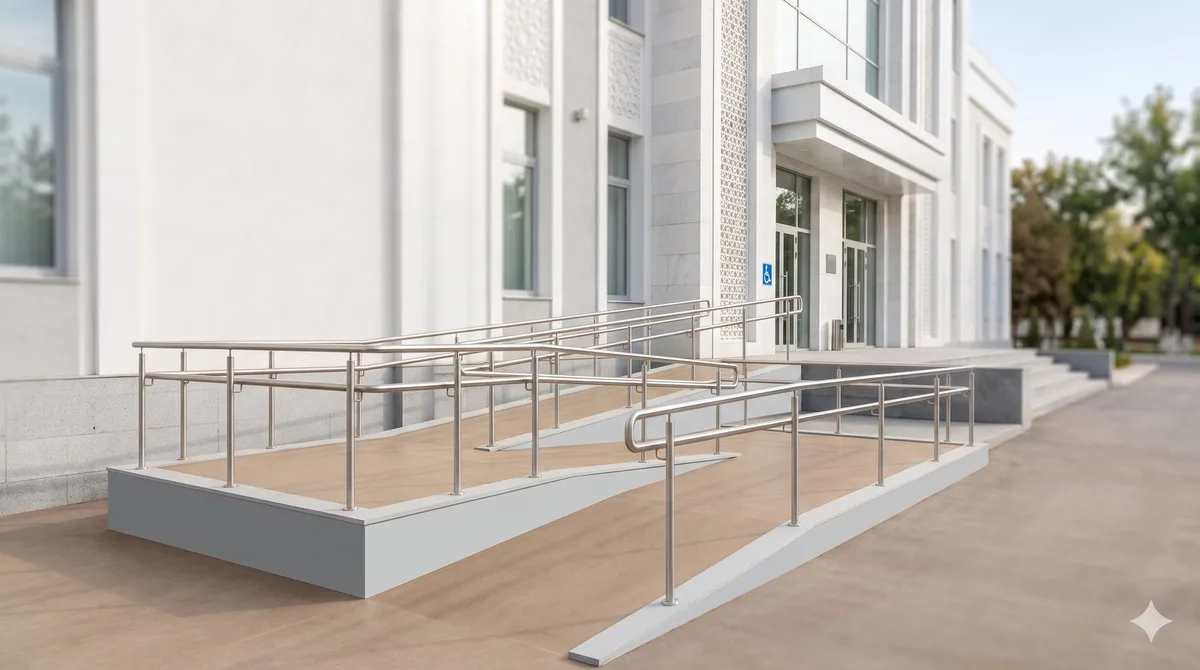
The ramp must be wide enough for a wheelchair to pass — as a rule, at least 0.9–1.0 m for one-way travel. Horizontal landings at the top and bottom are essential, so that a person can stop, open a door, and turn around. The minimum size of such a landing is about 1.5×1.5 m. Without landings, entering and exiting become dangerous.
Handrails and edge curbs
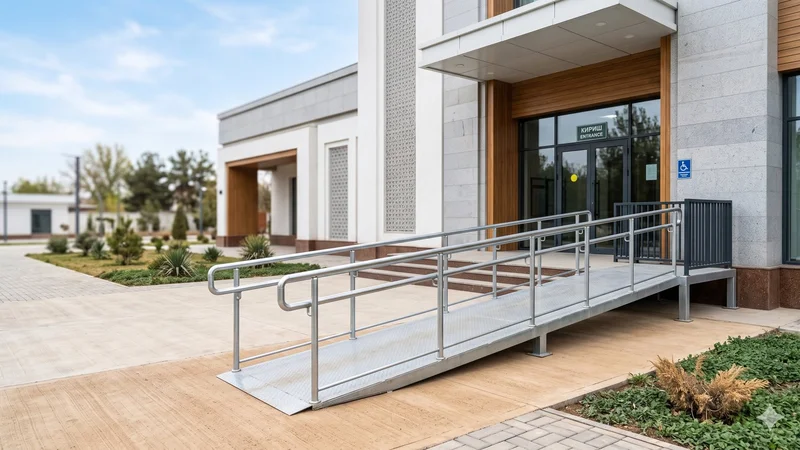
Handrails provide support and safety. They are installed on both sides of the ramp, usually at two heights (about 0.7 and 0.9 m), and for children's facilities a lower rail is also provided. A handrail should run continuously along the entire length of the ramp run and extend beyond it, so that a person can hold on both before starting and after finishing the descent.
An edge curb (wheel guard) at least 5 cm high is fitted along the sides of the ramp. It keeps a wheelchair wheel or a cane from slipping off the edge.
Surface and safety
The ramp surface must be durable and non-slip in any weather. A grooved, perforated, or special anti-slip surface is especially important on outdoor ramps, where rain, snow, and ice occur. Contrasting edge markings help people with low vision notice where the structure begins and ends.
Which ramp to choose
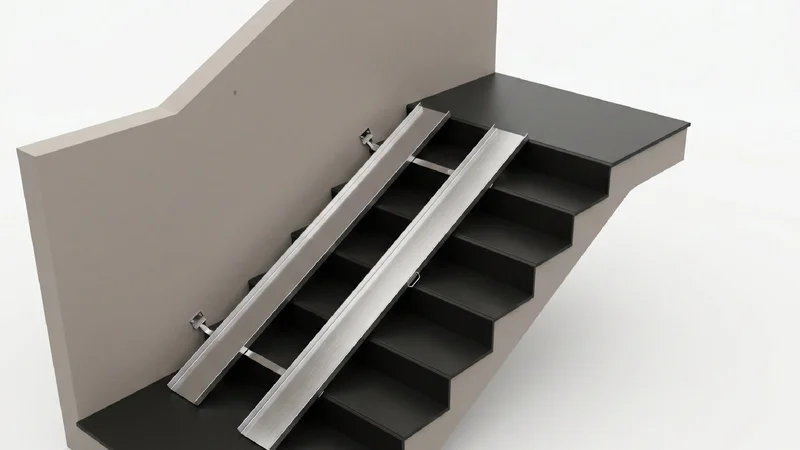
A permanent (fixed) ramp is suitable for a regular building entrance. For narrow staircases and entryways, folding models are convenient — they fold up and stay out of the way. For one-off needs — a trip, or getting over a single step — portable and telescopic ramps are used. Specialists can help you choose the right type and calculate the length to match the rise.
Where a ramp matters most
A ramp is needed anywhere there is a change in level between the street and an entrance or between floors: at the entrances to shops, pharmacies, clinics, banks, schools, and government offices, as well as in the entryways of residential buildings. Even a single step at an entrance can become an insurmountable barrier for a wheelchair user or a parent with a stroller. That is why a ramp is a basic element of an accessible environment and is most often where adapting a building begins.
Common mistakes when building a ramp
Even with the best intentions, a ramp sometimes turns out inconvenient. Here are the mistakes that come up most often:
- Slope that is too steep. A short, steep ramp may look like a ramp, but climbing it independently in a wheelchair is almost impossible. The slope matters more than the appearance.
- No landings at the top and bottom. Without a level area in front of the door, a person cannot stop and open the door while holding the wheelchair on the incline.
- No handrails or edge curbs. Without them the climb is unsafe, and a wheel or cane can slip off the edge.
- Slippery surface. Smooth metal or tile without an anti-slip layer is dangerous in rain and ice.
- A ramp leading nowhere. Sometimes the structure leads to a door that is too narrow or runs into a curb. It is important to plan the entire route as a whole.
Most of these mistakes are easy to avoid at the selection and design stage, when the parameters are calculated for the specific rise and the available space.
Frequently asked questions
What slope is considered comfortable? The most comfortable is around 1:20 (5%). Where space is limited, up to 1:12 is allowed, but the gentler the slope, the safer it is.
Are handrails needed on a short ramp? Handrails and edge curbs make a ramp safer even with a small change in level, so it is best not to skip them.
Can I install a ramp myself? Portable models require no installation. Fixed structures are best designed and installed with the relevant standards in mind — that way the ramp lasts longer and stays safe.
Need help choosing a ramp for your site? We will help you calculate the slope and length, build the structure to your dimensions, and handle delivery and installation. Browse ramps in the catalogue or get a free consultation.