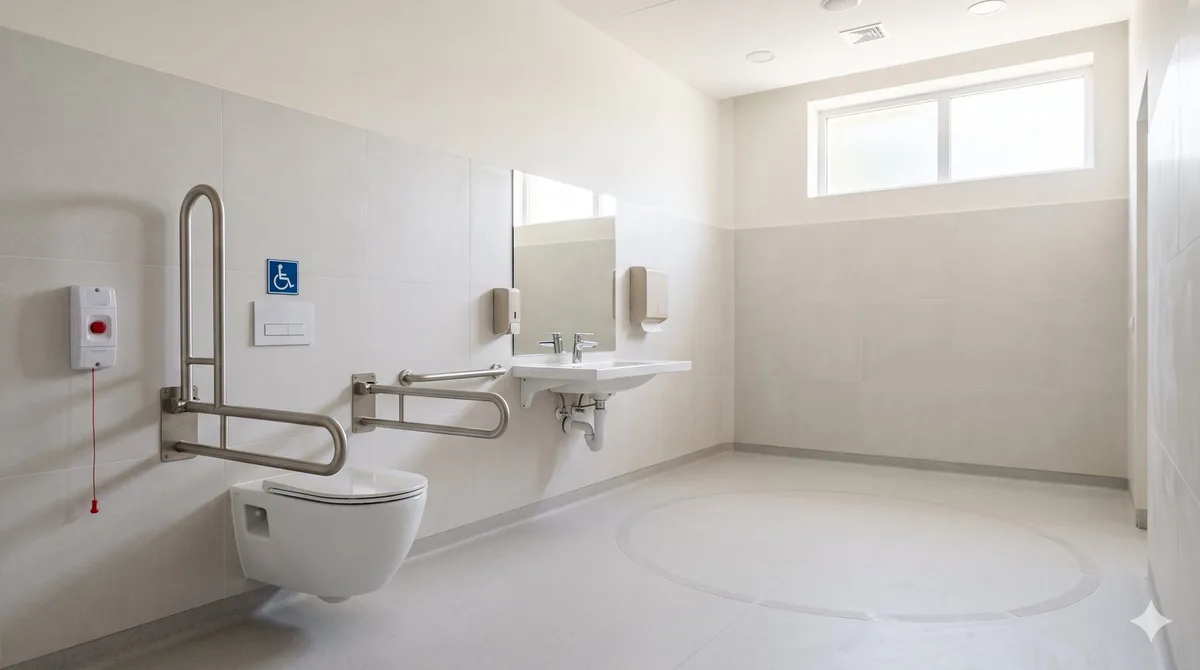
An accessible toilet for people with disabilities is far more than a room with a single grab rail on the wall. For a wheelchair user or someone with limited mobility to use the bathroom independently and safely, you need to plan the layout, the mounting heights of the sanitaryware, the grab rails and a system for calling for help. Below we look at what an accessible bathroom should be like and provide a ready-made setup checklist.
Turning space for a wheelchair
The key requirement for an accessible bathroom is a clear area in which a wheelchair can turn around. The benchmark is an unobstructed circle at least 1.5 m in diameter. Next to the toilet you should leave room for a side approach with the wheelchair, so that transferring is convenient and safe.
- turning area — at least 1.5 m in diameter;
- a side approach to the toilet on one or both sides;
- the washbasin and fittings should not obstruct wheelchair movement.
Toilet grab rails, including fold-down rails
Toilet grab rails are a key safety element. They help a person transfer from the wheelchair and keep their balance. Two types of rail are usually installed beside the toilet:
- a fixed (wall-mounted) rail on the wall side;
- a fold-down rail on the wheelchair approach side — it lifts up so the wheelchair can pull right in;
- support rails by the washbasin for extra stability.
The rails must support the weight of an adult, have a non-slip surface and be fixed to a solid wall base — designed with the requirements of applicable accessibility norms in mind.
Sanitaryware and mounting heights
The mounting height of the sanitaryware determines whether a person can use it from a wheelchair. Approximate values:
- toilet — seat height around 45-50 cm from the floor (level with the wheelchair seat);
- washbasin — lower edge roughly 65-70 cm so knees can fit underneath; tap — lever or sensor-operated;
- mirror — lower edge set below the usual height so it can be seen while seated;
- paper holder and hooks — within reach of an outstretched arm.
Help call button
A call button is an essential element of an accessible bathroom in public places. If a person feels unwell or falls, they need to be able to call for help.
- the button is placed by the toilet at a height of around 60-90 cm, plus an additional one low near the floor — so it can be reached while lying down;
- the signal should reach staff (both audible and visual);
- a pull-cord version is often used — it is easy to tug.
Non-slip flooring and door width
The bathroom floor should stay non-slip even when wet — this reduces the risk of falling. It is best to use matt tiles with an anti-slip finish, with no thresholds or changes in level.
- a level floor, no thresholds, with a non-slip finish;
- clear door width — at least 90 cm;
- the door opens outwards or slides — so it cannot trap a person who has fallen;
- handle — a lever type, easy to use with a weak hand.
Checklist and common mistakes
A short checklist for setting up an accessible bathroom:
- wheelchair turning area of at least 1.5 m;
- a fixed and a fold-down rail beside the toilet;
- toilet and washbasin at the correct height;
- a call button by the toilet and low near the floor;
- non-slip flooring with no thresholds;
- a door at least 90 cm wide that opens outwards.
Common mistakes: a door that is too narrow, no side approach to the toilet, slippery glossy tiles, rails fixed to flimsy plasterboard, and a forgotten call button.
Frequently asked questions
How wide should the door to an accessible toilet be? At least 90 cm clear width so a wheelchair can pass freely; it is best to make the door sliding or outward-opening.
Why do you need a fold-down rail? The rail on the wheelchair approach side lifts up so the chair can pull right up to the toilet, then folds down to provide support during the transfer.
Where should the call button go? By the toilet at a height of around 60-90 cm, plus an additional one low near the floor — so a person can call for help even while lying down.
Choosing grab rails, a call button and accessories for an accessible bathroom? Browse our catalog and get a free consultation on setting it up: accessible bathroom equipment.