A ramp is the most common solution for an accessible environment, but it doesn't work in every situation. When the change in height is large and there's no room for a long ramp, an accessibility lift comes to the rescue. This is a compact device that raises a person in a wheelchair or with limited mobility to the level they need. Let's look at when a lift is the better choice over a ramp, what types are available, and what to consider when choosing one.
When a ramp isn't enough
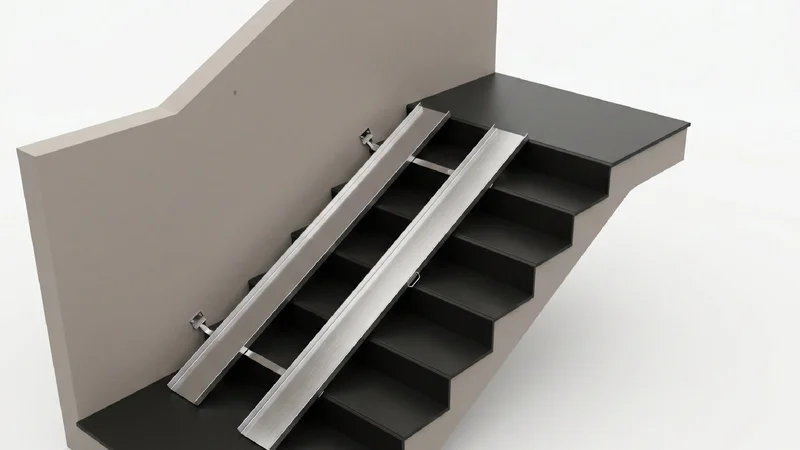
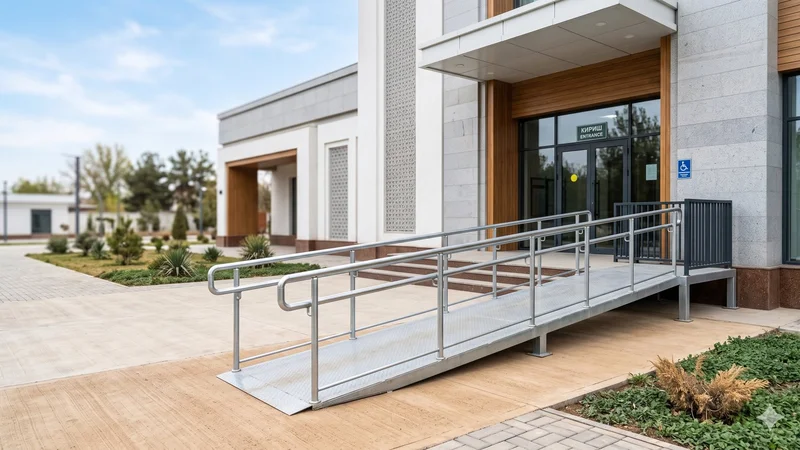
The slope of a ramp is limited, which means every metre of height calls for several metres of length. If an entrance is high and there's little space in front of it, a ramp either won't fit or ends up too steep and unsafe. In cases like these, a lift becomes the only realistic option.
- A large change in height — a tall porch, a basement level, a transition between floors.
- A narrow staircase with no room for a ramp of the required length.
- A historic or already-built structure where reworking the entrance isn't possible.
- Indoor staircases — in a building entrance, a school, a clinic, or an office.
Platform lift
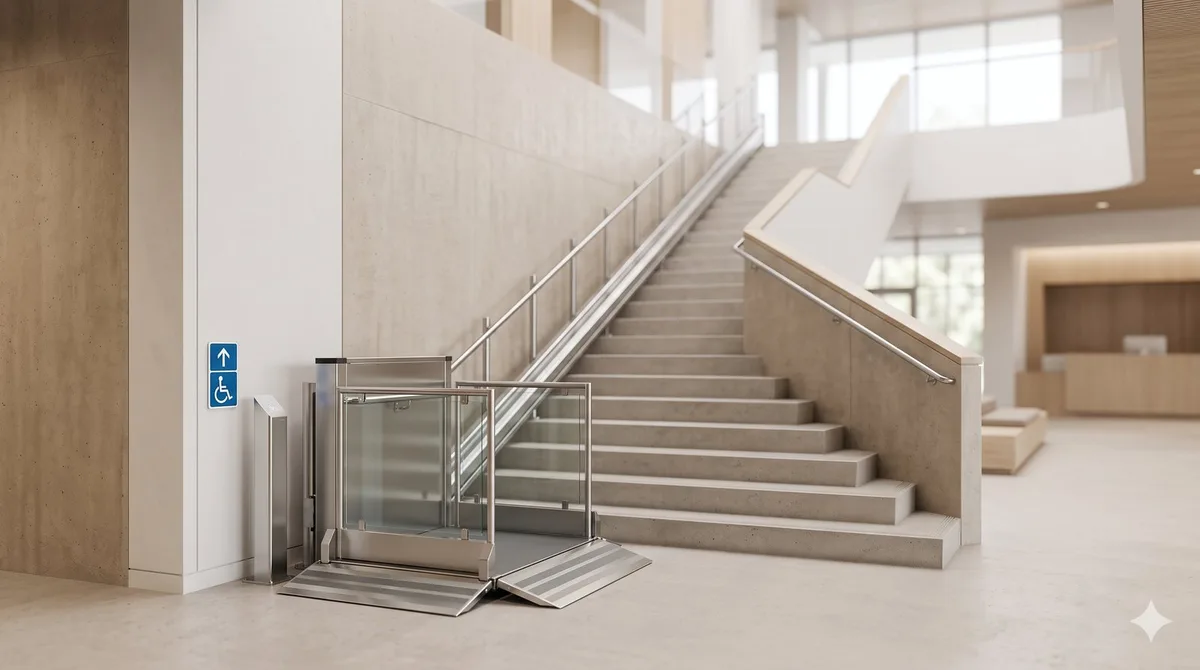
A vertical platform lift works like a small open platform that rises straight up along guide rails. It's a convenient solution for a change in height of up to a few metres — at a building entrance or between floors.
- Suitable for wheelchair users without any assistance.
- Can be installed both outdoors and indoors.
- Requires a level pad for the base and a power connection.
Stair lift
An inclined stair lift travels along the flight of stairs on a rail. The platform folds away when not in use and barely gets in the way of other visitors. It's a good solution where there's a staircase but no room for a separate shaft or platform.
- Mounts directly to the wall or steps along the staircase.
- Suitable for both straight and turning staircases.
- Saves space — it takes up very little when folded.
Mobile stair climber
This is a portable device that isn't fixed to the building. An attendant uses it to move a person in a wheelchair up and down the steps. A mobile stair climber is handy when fixed equipment can't be installed or you need a temporary solution.
- Requires no installation or rebuilding of the staircase.
- Can be used in different locations.
- Operates with a trained attendant present.
Lift or elevator
An elevator for people with disabilities is a full cabin in a shaft, designed for greater height and a steady flow of people. A lift is simpler and more compact, installed where a full elevator would be excessive or impossible. If a building needs to connect several floors with heavy traffic, an elevator is the choice; for one or two levels and a specific accessibility need, a lift is enough.
How to choose
- Measure the change in height and the available space — the type of device depends on this.
- Decide where the lift will go: outdoors it needs protection from precipitation and temperature.
- Consider who will use it — independently or with an attendant.
- Check the load capacity and the platform size to fit a wheelchair.
- Choose equipment designed with the requirements of applicable accessibility norms in mind and with easy controls.
Common mistakes
- Installing a ramp that's too steep where the height already calls for a lift.
- Failing to allow space for a wheelchair to turn at the entrance and exit of the platform.
- Forgetting about the power supply and preparing the base during installation.
- Choosing a mobile stair climber for constant use instead of a fixed lift.
Frequently asked questions
How does a lift differ from an elevator? An elevator is a cabin in a shaft for greater height and a flow of people, while a lift is more compact and addresses a specific accessibility need across one or two levels.
Can a lift be installed on an existing staircase? Yes, an inclined stair lift is mounted along the existing flight and doesn't require rebuilding the staircase.
What should I choose if there's no room for a ramp? With a large change in height and limited space, a vertical platform lift or a stair lift is a good fit — the exact type depends on the measurements.
Need help choosing
We'll select a lift to suit your site — based on measurements, the type of staircase, and your accessibility need. Browse lifts in the catalogue and get a free consultation.