At the entrance of many institutions you'll see a raised panel showing a plan of the building, dotted with the embossed marks of Braille text. This is a mnemonic scheme. To a sighted visitor it looks like an ordinary map, but for a blind person it is a complete navigation tool that takes the place of a glance around the room. Let's look at how it works.
What a mnemonic scheme is
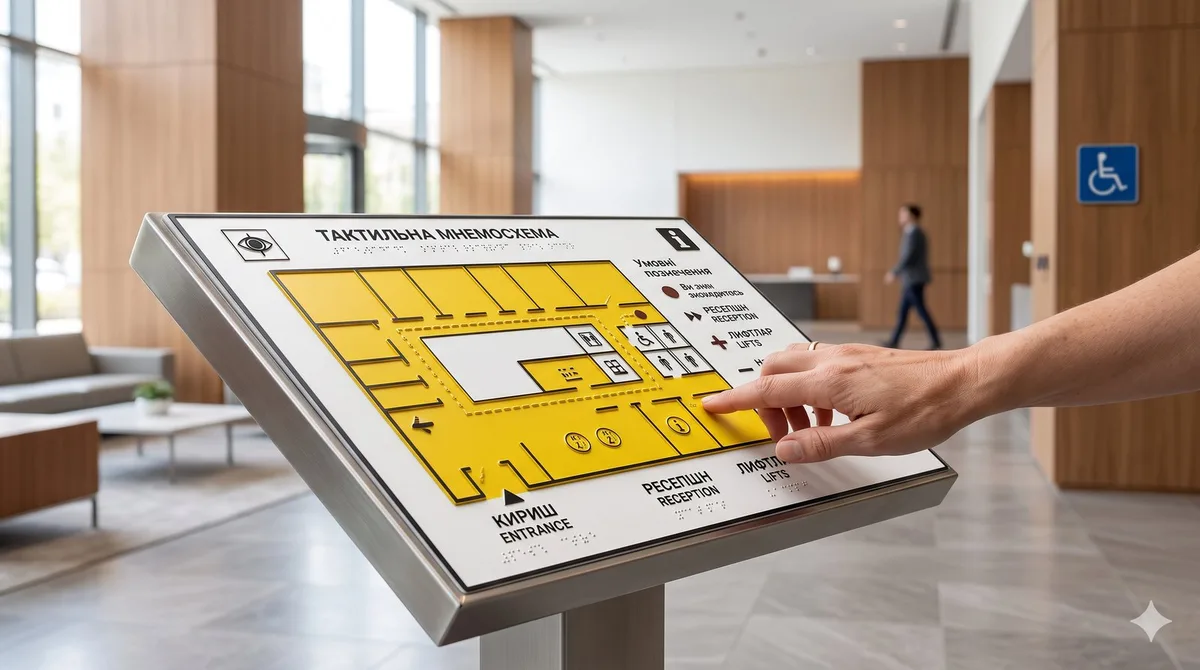
A mnemonic scheme is a tactile (raised) plan of a room or area. A blind person reads it with their hands, feeling the position of entrances, corridors, stairs, offices and restrooms. The labels are duplicated in Braille and in large high-contrast print, so that both blind and low-vision visitors can use the scheme.
How it differs from an ordinary plan
An ordinary plan is made for the eyes: you have to see it. A mnemonic scheme conveys the same information through touch. That gives it some distinctive features:
- raised lines and symbols that can be read with the fingers;
- Braille text for the labels;
- large high-contrast print and clear pictograms;
- a carefully chosen mounting height, so the scheme is easy to reach by hand.
Where mnemonic schemes are needed
Mnemonic schemes are installed wherever it matters that a person can understand the layout of a space from the moment they walk in: in hospitals and clinics, government offices, schools and universities, transport facilities and large shopping centres. The scheme is most often placed by the main entrance, close to the path people take.
How a mnemonic scheme fits into a navigation system
On its own, a mnemonic scheme gives a "map" at the start of the journey. But for a person to actually reach their destination, it needs to be part of a wider system. The scheme is supported by:
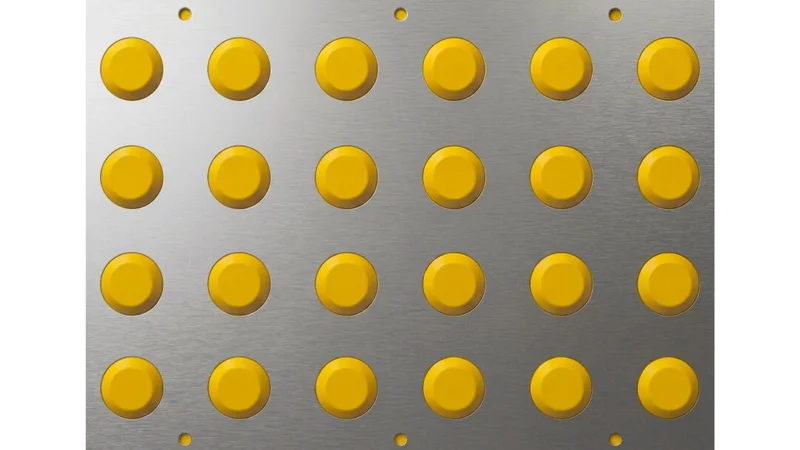
- tactile paving — it guides people along the route from the scheme to the points they need;
- tactile signs on office doors, showing the name and number in Braille;
- high-contrast marking on stairs and doors.
Together, these elements turn a building into an understandable space that a blind person can move through independently.
What to look for when choosing one
A good mnemonic scheme is an accurate plan of your specific building, not a generic picture. It's important to represent the real layout correctly, choose a suitable size and think through where it will be installed. The size and content are selected with the requirements of applicable accessibility norms and ease of reading in mind.
How a person reads a mnemonic scheme
A blind visitor finds the scheme (its location is often signalled by tactile paving), places their hands on the plan and "surveys" it with their fingers. Raised lines show walls and corridors, symbols mark stairs, lifts, entrances and restrooms, and the Braille labels name the rooms. In this way a person builds a mental image of the building before they even start moving: where they are now, where they need to go and what they'll encounter on the way. This is exactly why it matters that the scheme accurately mirrors the real layout — an error on the plan will send a person off course.
Durability and care
A mnemonic scheme is touched by hand every day, so the material has to be sturdy and resistant to wear. Quality schemes are made so that the relief and the Braille dots stay crisp for years and the surface is easy to clean. When choosing one, it's worth paying attention to how durable the material is and how precisely the relief is made — this directly affects how confidently a person can "read" the plan.
Frequently asked questions
Is a mnemonic scheme needed if there is already tactile paving? Yes. The paving guides people along the route, while the scheme gives an overall picture of the building at the start of the journey. They complement each other.
Is a single scheme enough for the whole building? For a small site, yes. In large buildings the scheme is placed at the entrance and supplemented on each floor with signs and directional markers.
Is Braille mandatory? Yes — it is what makes the scheme accessible to blind people. Large high-contrast print is also used for low-vision visitors.
We can help produce a mnemonic scheme based on your building's plan and put together a complete navigation system. View mnemonic schemes or get a free consultation.